
After seeing so many online creators, coaches and consultants vibe code their own software to share to their audience that can otherwise not afford their high ticked services, I predict that the next startup buzzword will be Experiential SaaS. There’s something slightly off about most SaaS products, and it’s hard to name at first, but once you see it, you can’t unsee it.
Sure they work, technically. Yes they have features. They even solve real problems.
And yet, using them feels fragmented, like you’re moving through a set of disconnected decisions instead of something that was actually designed to carry you from one state to another. That’s the gap. And I don’t think it’s a technology problem. I think it’s a design philosophy problem.
Why Software Still Feels Wrong
Most software today is built like an object.
You open it, you use a function, you leave. It behaves more like a tool you pick up and put down than something that understands where you came from or where you’re supposed to go next.
Which is strange, because humans don’t experience anything like that in real life. We experience sequences. We move through states. We enter something one way and leave it another.
And the more I think about it, the more obvious it becomes that software is still missing that layer entirely. In architecture, this problem was solved a long time ago. Not perfectly, but deliberately.
The Romans didn’t design bathhouses as a collection of rooms. They designed them as a route your body moves through, where each space only makes sense because of the one before and the one after it.
Hot, warm, cold. Caldarium, tepidarium, frigidarium.
The value wasn’t in any single room, it was in the sequence, in the way your body adjusted, in the transitions that made the whole thing feel almost ritualistic. Two thousand years later, we’ve somehow managed to forget that and replace it with furniture and subscriptions, respectively.
This analogy comes from architect Danny Dobson’s newsletter and he puts it perfectly:
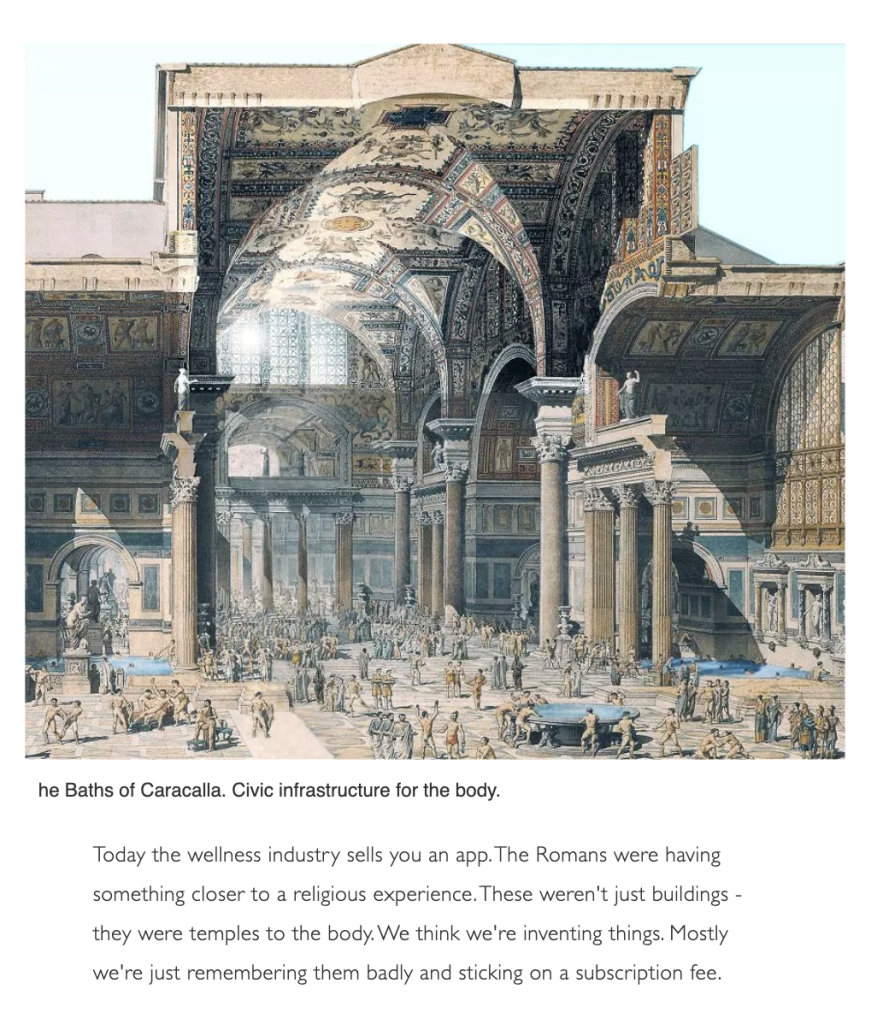
Every bathhouse from Pompeii to Bath was designed around the route between the three rather than the three themselves. The frigidarium at the Baths of Caracalla was a 30-metre vaulted hall held up on eight columns, with mosaic floors and clerestory light.
Today the wellness industry sells you an app. The Romans were having something closer to a religious experience. These weren’t just buildings – they were temples to the body. We think we’re inventing things. Mostly we’re just remembering them badly and sticking on a subscription fee.
If you look at most SaaS products through that lens, they start to feel incomplete. Not because they’re missing features, but because no one really designed the experience arc. You log in, and the product doesn’t know if you’re overwhelmed or confident or lost or just trying to get one thing done quickly before a meeting. It gives you the same interface regardless. Which means the user is doing all the cognitive work of stitching the experience together. That’s not proper UX/UI.
I have to mention that it’s 2026 and narrative has become way more important than the product itself. The experience is obviously not fully designed, the story has to carry the weight. The need for experiential SaaS is felt now more than ever.
Designer John Mauriello posted a video recently, a piece that he’s been working on for the past year. He mentioned that founders pivoted from asking “How do we build something that people genuinely want?” to asking “How do we create a reaction strong enough to keep the scheme going?”
For the investors it’s the pitch, for the audience it’s the landing page, for the clients it’s the promise of transformation.
We’ve seen this play out over and over again, especially in the last decade, where products didn’t need to fully work as long as they felt inevitable, as long as the story was strong enough to justify the gap between what exists and what’s being sold. And for a while, that worked. It was profitable to optimize for perception. But I think that perception has a shelf life and at some point, the actual experience catches up.
I think experiential SaaS is not just a design upgrade, but a structural shift. It changes the question from: “What features should we build?” to something much more difficult to track by agentic AI:
“What is the user becoming as they move through this product?”
Because now you’re not designing functionality. You’re designing transformation. And that requires a different level of precision. You start thinking in terms of states instead of buttons and screens and spacing.. Someone enters your product confused, or rushed, or slightly anxious about something they don’t fully understand yet. What happens next? Not in terms of UI, but in terms of how they feel. Do they get clarity immediately, or do they have to search for it? Do they build momentum, or do they hesitate? Do they leave with resolution, or with more tabs open than before? These are not soft questions. They are design variables.
What I feel is interesting is that most companies try to fix this too late. They build the product first, and then they try to layer experience on top of it, things like onboarding flows, tooltips, customer success, community, content.
It’s the equivalent of adding a heated towel rail to a house that was never designed for how someone actually moves through it at the end of a long day. It’s the living room with no seats facing each other. Sure, there are features there, but they don’t fix the core issue because the sequence was never designed in the first place.
There are, however, founders who are starting to see this differently, as in they’re not just thinking about interface or growth or even retention in isolation, they’re starting to think in terms of composition. It’s almost like directing a film, or designing a building, where timing, pacing, and transitions matter as much as the individual elements.
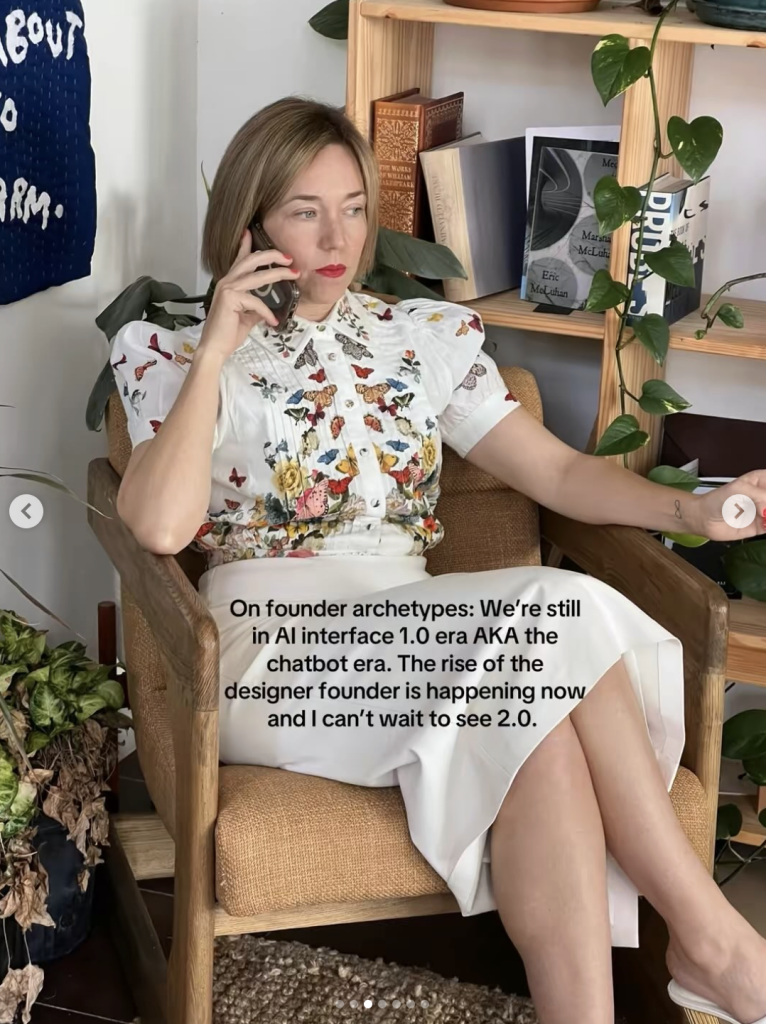
VC Kate McAndrew posted last week, on her Instagram:
On founder archetypes: We’re still in AI interface 1.0 era AKA chatbot era. The rise of the designer founder is happening now and I can’t wait to see 2.0.
I can’t wait to see it too, Kate. Because someone has to take responsibility for the experience as a whole. Not just the parts.
What to Do About It
If you want to approach your own product this way, the entry point is surprisingly simple, but also difficult to execute properly.You stop designing for the ideal scenario and you start designing for the worst one. The moment when your user is tired, distracted, slightly frustrated, and just wants something to work without thinking too much about it, well that is the real use case. It’s like when you’re carrying groceries into the house, or trying to decompress at the end of a long week. If your product works there, it works everywhere.
From there, you can define the arc, not the feature list, but the transformation. What changes from the moment they enter to the moment they leave? Then you design everything around supporting that change, which also means removing anything that doesn’t. Unnecessary steps are not neutral, they’re disruptive because they break the flow.
This is the part that I think most SaaS products still don’t get.
They treat experience as a consequence of feature implementation. They don’t design the experience first and use the features as tools of expressions. The experience itself is structure and time spent on app is more valuable than the number of “active” users. Experience is not decor. If the experience, the structure, is wrong, everything else becomes a reactionary compromise.
I keep coming back to that idea from architecture, that the most important design decision is not what something looks like, but what it does for you on your worst day. That’s when value is created. I believe software is no different.